As an Amazon Associate I earn from qualifying purchases.

Apple’s M6 keeps the iMac current without shaking things up much.
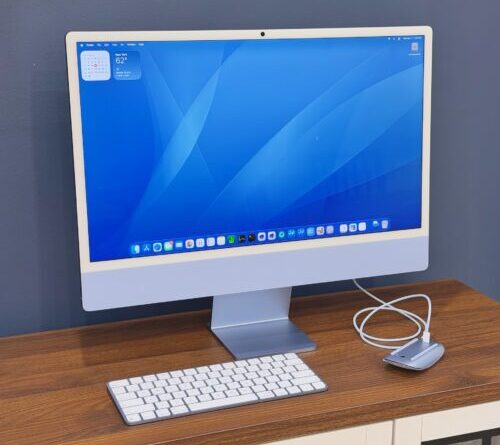
Apple’s M6 iMac.
Credit: Andrew Cunningham
Apple’s M6 iMac.
Credit: Andrew Cunningham
The Apple Silicon iMac got its 4th refresh this month.
Every other Apple Silicon Mac has actually discovered a method to move on over the last half-decade– we’ve gotten a more Pro style for the MacBook Pro, a mini-er style for the Mac mini, and a Mac Studio that has actually lastly made Apple confess does not wish to make the Mac Pro any longer.
The Apple Silicon iMac has actually constantly been more interested in looking backwards. It’s the thin, screen-on-a-stand iMac style by method of the initial Bondi Blue G3 iMac. It’s a tidy and beautiful desktop, one I see all the time in little workplaces and on television programs that portray little workplaces. We’re long past the days when it was Apple’s main workstation computer system.
I desired to compose about this brand-new iMac from the point of view of that entry-level iMac purchaser, who picks the iMac since it’s easy and then utilizes it up until it breaks. What does a brand-new iMac get you if you’re stepping up from the M1 design or comparing it versus an older reconditioned M4 design? With no genuine external updates, what makes this iMac version fascinating?
Very same friendly face
If you have not utilized an Apple Silicon-era iMac in the past, here’s a quick guide.
The brand-new iMac is much thinner than the older aluminum Intel designs. Its front is mainly one huge 24-inch screen, surrounded on all sides by a reasonably thick white bezel (I still want black were at least an choicehowever Apple obviously does not concur).
White bezel aside, it’s without a doubt Apple’s many vibrant computer system. The iMacs ship with color-matched fronts, backs, stands, keyboards, mice, trackpads, and cable televisions. Apple has actually fine-tuned the color offerings and altered the tints of each particular color a couple of times throughout the years, however the M6 iMac utilizes the exact same 6 color tints (plus silver) that the M4 iMac did.
The fundamental $1,499 iMac is basically a MacBook Air in regards to ports– it has 2 Thunderbolt ports on the back and an earphone jack on the left side. Picking this design likewise locks you into a lower variation of the Apple M6 with 10 CPU cores and 10 GPU cores rather of 12 of each, an optimum of 24GB of RAM, a minimum of 256GB of storage, and an optimum of 1TB. Its default keyboard does not have Touch ID assistance, and the only method to get it is to purchase the variation with the integrated number pad, an $80 upsell.
The M6 iMac still includes either 2 or 4 Thunderbolt 4 ports. The four-port variation can run 2 external display screens; the one-port variation is restricted to one. Ethernet is readily available on the power brick for an additional$ 30.
Credit: Andrew Cunningham
The M6 iMac still includes either 2 or 4 Thunderbolt 4 ports. The four-port variation can run 2 external display screens; the one-port variation is restricted to one. Ethernet is offered on the power brick for an additional $30.
Credit: Andrew Cunningham
The$1,699 variation is the one to get if you still plan to utilize the iMac as a workstation. It consists of the full-speed variation of the M6 with all its CPU and GPU cores undamaged (though there are efficiency cautions here we’ll speak about later on), plus alternatives for 32GB of RAM and approximately 2TB of storage. This variation likewise consists of 4 Thunderbolt ports on the back for linking extra devices. Both offered keyboards on this variation have Touch ID.
A 2.5 gigabit Ethernet port can be contributed to any iMac for $30. This port lies on the desktop’s power brick instead of the iMac itself, a sophisticated option that keeps even a wired Internet connection concealed underneath your desk with the other cable televisions. All iMacs likewise provide a VESA install adapter alternative in location of the default stand at no additional charge.
I still truly like the result produced by the color-matched keyboard, mouse/trackpad, and cable televisions– even the white bezel matches the white keycaps and mouse. Feel in one’s bones you’re paying rather a lot for how the desktop looks. The $899 Mac mini is $800 less expensive than the iMac with the very same chip, the exact same quantity of RAM, and the exact same quantity of storage. Sure, it would cost something to include a nice-looking 4K screen, however not $800, even if you choose additional frills like a high refresh rate.
It’s great that the iMac upcharges you for design and benefit. That’s the point of the computer system. Simply ensure that’s what you wish to spend for.
The development of the iMac
Here are the standard specifications for every single entry-level iMac Apple has actually delivered, going all the method back to the last of the Intel designs.
The iMac’s development has actually been sluggish and progressive throughout the Apple Silicon age. The computer system has actually never ever gotten a base storage upgrade, and the base M4 and M6 designs still just support a single external screen (the updated designs support 2 external screens, lastly exceeding the old Intel design).
If you haveany type of Apple Silicon iMac and you’re delighted with how it’s carrying out and you’re not liking more RAM or more screens, I do not believe the M6 design actually includes anything worth updating for. It’s certainly much faster, however even 6 years on, the Apple M1 stays completely functional for everyday usage, particularly when it’s connected to 16GB of RAM.
And if you’re in the marketplace for an iMacnowI believe the M4 design still gets you the very best value if you can discover one reconditioned or on sale. That a person still gets you a minimum of 16GB of RAM, Thunderbolt in all 4 ports for the four-port design, the 32GB RAM choice, the nano-texture screen choice, and assistance for numerous external display screens (once again, in the four-port design).
The M6 iMac develops on that, and it includes genuine efficiency advantages (more on that quickly). The brightest dividing line in the Apple Silicon iMac design history is in between the M3 and M4 design, not the M4 and M6 design. Which’s real regardless of the two-generation silicon upgrade.
Efficiency and power
A fast wrap-up on the M6: an overall of 12 CPU cores (2 extremely cores, 4 efficiency cores, 6 performance cores), either 10 or 12 GPU cores, 16/24/32GB RAM choices, and a doubled Neural Engine NPU with 32 cores rather of 16. For the iMac, the M6 likewise presents a few of the architectural tweaks presented with the Apple M5, consisting of the addition of neural accelerator hardware to the GPU cores. This enhances the speed of some sort of regional AI work compared to the M4, consisting of MetalFX upscaling and frame generation in video games.
The M6 in the Mac mini and the M6 in the 14-inch MacBook Pro both carry out likewise within an approximately 28 W continual power envelope. The variation with 16GB of RAM will carry out somewhat even worse in video games and other work conscious memory bandwidth– the 16GB M6 uses 153 GB/s of memory bandwidth, and the 24GB and 32GB variations provide 170 GB/s. That’s a lovely small distinction.
The iMac is slower than either of those 2 Macs, especially in multi-core CPU criteria and graphics criteria, and the HandBrake video encoding test reveals the most likely offender. The iMac’s M6 takes in approximately 18 W of power under continual heavy load. It will not throttle its speeds as strongly as a MacBook Air due to the fact that the iMac still consists of an active cooling fan, however the minimized power envelope does indicate that the Mac mini or MacBook Pro are 5 to 8 percent much faster than the iMac in heavy multi-core CPU jobs and about 8 to 12 percent much faster in graphics criteria.
One advantage of the smaller sized power envelope is that the iMac’s chip is much more power-efficient than the routine M6 and the iMac’s variation of the M4, utilizing much less power to do the very same quantity of work.
That still makes it a strong upgrade over the M4. The iMac’s M6 is 15 to 20 percent quicker in our single-core CPU criteria, in between 20 and 30 percent quicker in multi-core CPU standards, and in between 20 and 40 percent quicker in graphics standards (the Blender GPU standards do even much better– they appear to like the neural accelerators in the M5 and M6 GPUs). Particularly with 24GB or 32GB of RAM, it’s completely efficient in being the heart of a multi-monitor workstation setup or a light photo/video modifying rig.
What fulfills the eye
The M6 iMac modifications nearly absolutely nothing about who the iMac is for, its position in Apple’s lineup, or what it’s technically efficient in. It’s a box-ticking upgrade, and package being ticked is “keep the withins approximately date.”
That indicates today’s iMac is finest for the exact same type of computer system users it benefited in 1998: individuals who do not desire a laptop computer, individuals who require a friendly and friendly kiosk or workplace computer system, and individuals who simply desire something quite that does not need a great deal of fussing with screens or cable televisions.
That’s the main point I miss out on about being an iMac user. I like how my present Mac Studio desktop works, and I require versatility and intricacy in my particular setup to get the Mac and a video gaming PC linked to all the very same things. Regardless of my finest efforts, the cable television circumstance has actually constantly been a hardly handled mess.
If somebody you understand has a cable television management issue and does not requirement the intricacy, congratulations, you’ve discovered somebody the iMac is for. I simply want Apple would utilize these sort of quite, saturated colors in a laptop computer or desktop that fulfills myrequirements, you understand?
The great
- A beautiful and capable desktop that lessens the cable television mess that a lot of desktops make
- Energy effective and peaceful, on the uncommon celebrations when you can hear the fan spinning at all
- Apple M6 is quickly, and specifically with 24GB or 32GB of RAM, will be more than efficient in managing most jobs
- Like the M4 variation, it can support several external screens if you spend for the quicker chip
The bad
- Minimal port choice
- Expenses $200 more than the M4 design did when it introduced
- Still simply 256GB of base storage
- Somewhat slower than M6 variations of the Mac mini and MacBook Pro
- TouchID is an $80 upgrade for the base design
Andrew is a Senior Technology Reporter at Ars Technica, with a concentrate on customer tech consisting of hardware and extensive evaluations of running systems like Windows and macOS. Andrew resides in Philadelphia and co-hosts a weekly book podcast called Overdue.
93 Comments

Learn more
As an Amazon Associate I earn from qualifying purchases.