As an Amazon Associate I earn from qualifying purchases.

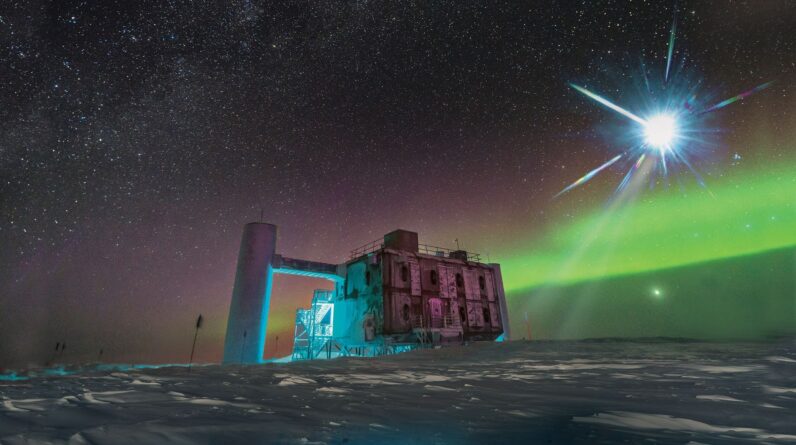
Because coming online in 2011, The IceCube Neutrino Observatory has actually been capturing ‘ghost particles’underneath the South Pole in a look for brand-new physics. This October, it won its visionary a Nobel Prize.
(Image credit: IceCube/ NSF)
When Francis Halzen initially proposed burying a $ 271 million telescope deep below the South Pole, he anticipated to be chuckled off phase. 4 years later on, it won him a Nobel Prize.
Including countless light sensing units strung like rosary beads inside a cubic kilometer (0.2 cubic miles) of beautiful ice, his detector, appropriately called IceCube, is not an apparent method to study deep space. Halzena theoretical physicist at the University of Madison-Wisconsin, isn’t searching for something apparent.
Ben Turner is the functions editor at Live Science. He covers physics and astronomy, to name a few subjects such as tech and environment modification. He finished from University College London with a degree in particle physics before training as a reporter. When he’s not composing, Ben delights in checking out literature, playing the guitar and losing at chess.
You should validate your show and tell name before commenting
Please logout and after that login once again, you will then be triggered to enter your display screen name.
Find out more
As an Amazon Associate I earn from qualifying purchases.