As an Amazon Associate I earn from qualifying purchases.

A scorpion that lived approximately 316 to 319 million years earlier (Carboniferous duration) is the earliest recognized member of the modern-day scorpion family tree in North America, according to a group of paleontologists from Flinders University in Australia, the American Museum of Natural History and the University of Alabama.
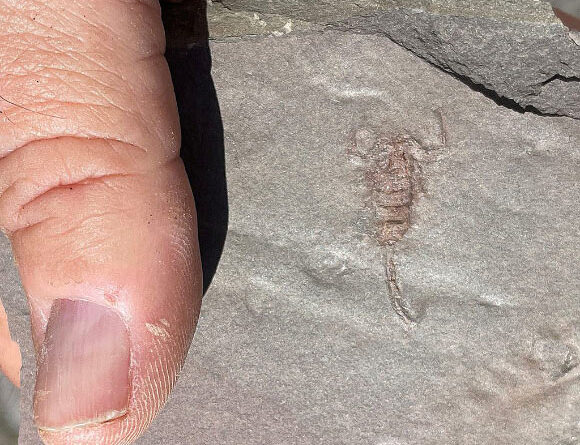
The fossil scorpion from the Union Chapel Mine in Walker County, Alabama, the United States. Image credit: Prescott Atkinson.
“Well before dinosaurs wandered the world, the scorpions, millipedes and dragonfly loved ones of 315-320 million years earlier were usually much bigger than they are today,” stated Flinders University paleontology trainee Genevieve (Gen) Conway, lead author of the research study.
“That is why we presume this fossil might be a juvenile, and among the very first of its kind to be taken a look at and linked to the development of contemporary scorpions on the North American continent.”
The fossil, about 22 mm long, is most likely a molt, the shed skin of a young scorpion.
The specimen was discovered at the Union Chapel Mine in Walker County, Alabama.
The website becomes part of the Pottsville Formation and is popular for fossilized footprints of ancient animals.
“It’s the very first fossil scorpion from this understudied website where great deals of trackways have actually been discovered, consisting of other fossils, by amateur fossickers and scientists,” stated co-author Dr. Russell Bicknell, a paleontologist at Flinders University.
“The Pottsville Formation in Alabama, and other fossil websites like it around the globe, and might consist of a lot more discoveries to assist us comprehend.”
“Even after a quarter century of gathering, crucial specimens keep being discovered and looked into,” stated co-author Dr. Adiel Klompmaker, a paleontologist at the University of Alabama.
“Another example is a current report on shark teeth from the mine. Together, these finds provide a progressively in-depth image of ancient communities in Alabama.”
According to the paleontologists, some trackways at the website were made by scorpions, though they can not state whether an animal this size made them.
They utilized ultraviolet light to highlight information that are less noticeable under normal lighting.
The images revealed what seem breathing pores, called spiracles, situated within the stubborn belly plates instead of along their edges.
This plan puts the animal in Orthosterni, the group that consists of living scorpions.
Curved lines on the plates might likewise be traces of book lungs, the breathing organs of contemporary scorpions.
The specimen does not have functions such as the plates at the base of the legs and the lateral eyes.
The scientists discovered it unique from the only other scorpion understood from the Pottsville Formation, which has actually lobed stubborn belly plates.
Chemical analysis revealed the fossil is made practically totally of carbon, constant with heat modifying the chitin of the initial shell.
“This scorpion has a large and big metasoma, or the long sector at the end of the scorpion with a poisonous stinger on its pointer, and little and narrow pincers,” Conway stated.
“In living scorpions, this shape is connected with scorpions that are rather poisonous and tend to utilize venom for defense and victim capture, and typically consume little fast-moving bugs.”
The specimen represents the very first fossil scorpion from the southeastern United States.
The only other comparably early, total orthostern scorpion originates from Britain, and older orthostern-like pieces are understood from Scotland.
The Alabama specimen discover assists limit when modern-type scorpions emerged.
“Remarkably, this types appears extremely comparable to the qualities of scorpions alive today, consisting of those in Australia,” Conway concluded.
The group’s findings appear in The Science of Nature
_____
G.A. Conway et al2026. Earliest North American orthostern scorpion from the Carboniferous (Pennsylvanian: Bashkirian) Pottsville Formation of Alabama, USA. Sci Nat 113, 140; doi: 10.1007/ s00114-026-02180-6
Find out more
As an Amazon Associate I earn from qualifying purchases.