As an Amazon Associate I earn from qualifying purchases.

Avoid to content
Determination is having difficulty sending to Earth. Odyssey is quickly burning through its subsiding fuel supply.
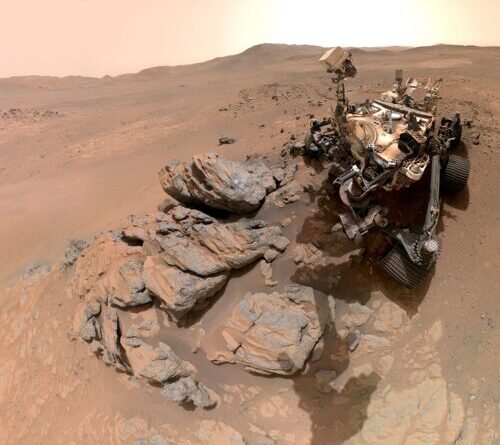
NASA’s Perseverance looks down at a rocky outcrop nicknamed “Arathusa” in this selfie mosaic produced utilizing images drawn from the automobile’s robotic arm.
Credit: NASA/JPL-Caltech/MSSS
2 of NASA’s 4 objectives running at Mars have actually suspended science operations after coming across different technical problems in current weeks.
The objectives impacted by the blackouts—ideally short-term—are NASA’s Perseverance rover and Odyssey orbiter. Both are running beyond their initial style life times. Determination remains in its 6th year checking out the surface area of Mars, having actually gathered rock and soil samples for ultimate go back to Earth. The rover is now studying the rim of a crater that when consisted of an ancient lake of liquid water. Odyssey showed up in orbit around Mars in 2001, and is the longest-lived Mars objective in history.
Losing its voice
The issue on Perseverance comes from the rover’s interactions system. The rover has 2 redundant UHF radios for high-rate interactions with a fleet of orbiters that communicate information to Earth. A different X-band system is readily available for direct-to-Earth interactions at a lower information rate.
Among the rover’s 2 UHF radios was unresponsive when it powered up on October 30, activating an automated switch to the backup radio and putting the rover in safe mode. Ground groups at NASA’s Jet Propulsion Laboratory in California later on found the backup UHF radio was transferring at about half of its anticipated power output, NASA stated in a declaration recently.
“The group has actually stopped utilizing both radios till they can assess possible reasons for the problems and one or both are considered safe to resume running,” NASA stated.
Determination is now sending signals straight to Earth in X-band, however the connection supplies a “considerably lower information rate” than passing on signals through orbiters utilizing the UHF radios. Objective supervisors stopped briefly the rover’s science operations “out of an abundance of care” as they examine the radio issue. Their preliminary focus is on getting the backup UHF radio running before turning their attention on recuperating the main radio, NASA stated.
“The group is confident the rover might go back to science by the end of November.”
The six-wheeled robotic broke a record last month for the farthest any lorry has actually driven on another world. The Perseverance rover went beyond the 28.06-mile (45.16-kilometer) mark set by NASA’s Opportunity rover, which quit working in 2018. Determination’s odometer now sits at two times the rover’s initial objective for range took a trip.
Operating on fumes
The scenario with the Odyssey orbiter appears more alarming. Among the 4 response wheels utilized for pointing the spacecraft stopped spinning in early November, leaving Odyssey with 2 great wheels after the very first one stopped working in 2013. The orbiter requires a minimum of 3 wheels to keep it oriented properly.
“Without the 3 response wheels, the spacecraft should rely exclusively on its hydrazine thrusters to stay focused,” NASA stated. The orbiter needs steady indicating turn its solar ranges towards the Sun and its science instruments towards Mars.
Odyssey was running low on propellant before the response wheel breakdown, however supervisors were positive that with “exceptionally low” fuel use, the orbiter would have enough to continue running through a minimum of completion of 2028, stated Jeffrey Plaut, Odyssey’s task researcher at JPL, in a discussion previously this year.
That presumed no failures in Odyssey’s 3 staying response wheels. Without 3 healthy wheels, engineers approximate the spacecraft has enough hydrazine fuel to last one to 2 months, NASA stated. Fortunately is ground groups had some preliminary success repairing the balky response wheel. Additional screening is needed to figure out whether the wheel is recoverable.
Aging facilities
Odyssey is among 4 orbiters NASA utilizes to pass on information in between Earth and the Perseverance and Curiosity rovers on the Martian surface area. Interest is still driving and gathering information after 14 years on Mars. The other 3 relay craft are NASA’s Mars Reconnaissance Orbiter, which reached the red world in 2006, the European Space Agency’s 10-year-old ExoMars Trace Gas Orbiter, and ESA’s 23-year-old Mars Express spacecraft.
NASA lost contact with its MAVEN orbiter last December after 11 years of operations at Mars when the spacecraft unexpectedly drew out of control. An examination might not recognize a particular origin, however engineers concluded that a radiation-induced single occasion upset or a software application problem triggered MAVEN’s flight computer system to reboot, according to Tiffany Morgan, director of NASA’s robotic Mars Exploration Program.
The spacecraft’s inertial measurement system stopped working to offer the computer system with right details on MAVEN’s orientation, triggering it to spin in action to the defective information, Morgan stated in a November 9 discussion to the Mars Exploration Program Analysis Group.
NASA is preparing to send out supports to restore the firm’s existence at Mars. In September, NASA granted Blue Origin a $700 million agreement for the Mars Telecommunications Network (MTN), an orbiter devoted to supplying high-bandwidth connection in between Earth and other objectives running on and around the red world.
NASA desired Blue Origin to finish the telecom orbiter by the end of 2028 and have it functional at Mars in 2030. The Mars Telecommunications Network is on hold after Rocket Lab, which lost its quote to win the MTN agreement, submitted a demonstration with the Government Accountability Office. The GAO is anticipated to rule on the demonstration next month, at which time Blue Origin might begin deal with the NASA agreement if the federal government turns down Rocket Lab’s petition.
Another Mars objective, SkyFall, might likewise release in 2028. NASA intends to send out 3 helicopter drones to Mars to check out the world’s geology and weather condition from the air.
A seasonal top priority for Mars researchers is changing the special high-resolution mapping video camera on the aging Mars Reconnaissance Orbiter. Such an ability will assist recognize landing websites for future robotic and human objectives, consisting of a prospective objective to return Perseverance’s rock specimens to Earth.
NASA remains in the extremely early phases of establishing an objective principle that might take control of MRO’s imaging ability, however there’s no company schedule or spending plan for such an endeavor. NASA will likely depend on MRO for landing-site reconnaissance well into the 2030s.
Stephen Clark is an area press reporter at Ars Technica, covering personal area business and the world’s area companies. Stephen blogs about the nexus of innovation, science, policy, and organization on and off the world.
29 Comments

Learn more
As an Amazon Associate I earn from qualifying purchases.