As an Amazon Associate I earn from qualifying purchases.

A 2-million-year-old jaw of a young Australopithecus africanus person has actually shown up an uncommon function– a safe bony ridge that forms on the within the lower jaw– that researchers had actually presumed was a fairly current peculiarity of contemporary people.
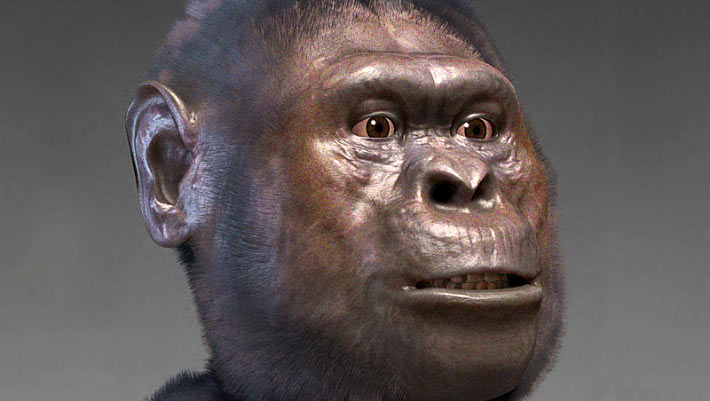
Forensic facial restoration of another Australopithecus types — A. afarensisImage credit: Cicero Moraes/ CC BY-SA 3.0.
” Finding such a noticable, totally formed ridge in a young fossil specimen, where no other juvenile fossil of its kind reveals it, is extremely unanticipated,”stated La Trobe University Ph.D. trainee Luca Morris-Obst.
“It makes our forefathers relatable. It humanizes our ancient loved ones, revealing that even subadult hominins experienced the specific very same safe physiological curiosity and jaw variations that we go over at the dental professional’s workplace today.”
Referred to as a mandibular torus, the jaw function appears on both sides of a fossil called Sts 52b.
The specimen comes from Australopithecus africanus and was excavated at Sterkfontein, near Johannesburg in South Africa, in 1949. The deposits that held it are dated to in between 2.8 and 2.1 million years earlier.
Mandibular tori are safe and typical today, specifically in cooler areas.
They appear in majority of individuals in circumpolar populations, however in just about 3% of individuals in Africa.
Their cause stays uncertain; scientists have actually indicated genes, heavy chewing forces, teeth grinding and gum illness.
The existence of the mandibular torus in Sts 52b makes complex the chewing-force description.
The person was a teen whose 2nd molars had only simply emerged, whereas such developments are generally reported in grownups.
And the greatly developed Paranthropus robustuswhose jaws endured severe chewing tensions, has actually disappointed a single example.
Paranthropus boiseiImage credit: © Roman Yevseyev.
Morris-Obst and coworkers likewise discovered no indication of dental caries, infection or uncommonly heavy wear in Sts 52b.
The scientists conclude that strong bite forces alone can not discuss the quality.
They recommend it might rather show an unusual hereditary abnormality that was unusual for some 2 million years before ending up being more extensive in human populations over the previous 10,000 years approximately.
“The finding indicated a more intricate photo of how the human jaw established,” Morris-Obst stated.
“Because the mandibular torus is uncommon in the fossil record, even ‘robust’ hominins with huge chewing muscles that produce severe masticatory tension absence this function.”
“Therefore, high chewing forces alone can not describe the incident of this benign bony ridge.”
The research study was released in the journal Evolutionary Human Sciences
_____
Luca Morris-Obst et al2026. A deep time point of view on an uncommon physiological variation: Torus mandibularis existence in Australopithecus africanus from Sterkfontein, South Africa. Evolutionary Human Sciences 8: e42; doi: 10.1017/ ehs.2026.10070
Find out more
As an Amazon Associate I earn from qualifying purchases.