As an Amazon Associate I earn from qualifying purchases.

“DART made an actually, actually big mess. We didn’t actually understand what kind of mess.”
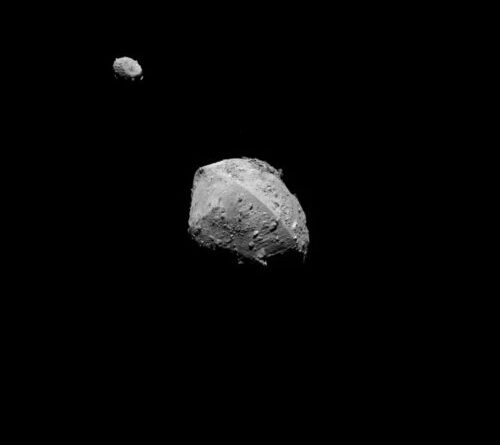
This image from the Hera spacecraft’s asteroid framing electronic camera reveals Didymos and its smaller sized buddy Dimorphos, exposing the stadium-sized crater developed by the effect of NASA’s DART spacecraft in 2022.
Credit: European Space Agency
This image from the Hera spacecraft’s asteroid framing cam reveals Didymos and its smaller sized buddy Dimorphos, exposing the stadium-sized crater developed by the effect of NASA’s DART spacecraft in 2022.
Credit: European Space Agency
4 years back, NASA dispatched a little spacecraft on a suicide objective to demonstrate how humankind may deflect an asteroid on a clash with Earth. The first-of-its-kind experiment worked magnificently as the solar-powered area probe knocked into asteroid Dimorphos, completely changing its trajectory.
Utilizing telescopes, astronomers determined modifications in the orbit of Dimorphos around a bigger asteroid buddy called Didymos in the after-effects of NASA’s Double Asteroid Redirection Test (DART) objective. The spacecraft launched some 10 billion joules of energy as it affected Dimorphos in September 2022 at more than 13,700 miles per hour (6.14 kilometers per second), reducing the asteroid’s 12-hour orbit around Didymos by about 33 minutes, 25 times the most conservative expectation.
Researchers might just discover so much from DART. The crash ruined the spacecraft, as anticipated. DART tape-recorded images as it took objective on Dimorphos, however just far telescopes and a little CubeSat that briefly identified the effect flash might see what took place next.
“We understood immediately that the effect achieved success, that DART made a truly, truly big mess,” stated Sabina Raducan, a planetary researcher at the International Space Science Institute in Bern, Switzerland. “However, we didn’t truly understand what sort of mess. We were still missing out on pieces of the puzzle.”
Artist’s illustration of the Hera spacecraft with its 2 deployable CubeSats, Juventas and Milani, in the area of the Didymos binary asteroid system.
Credit: ESA-Science Office
Artist’s illustration of the Hera spacecraft with its 2 deployable CubeSats, Juventas and Milani, in the area of the Didymos binary asteroid system.
Credit: ESA-Science Office
Following up
The European Space Agency’s Hera spacecraft just recently got here in the area of Didymos and Dimorphos after a two-year journey from a launch pad in Florida. On Wednesday, ESA launched Hera’s very first views of the scar left by DART on Dimorphos. The images reveal the car-sized impactor took a crater the size of an arena, almost as huge as Dimorphos itself, a rugged piece of extraterrestrial rock determining about 500 feet (151 meters) throughout.
Objective coordinators picked Didymos and Dimorphos for the deflection experiment since they resemble numerous near-Earth asteroids, however there’s no threat of them striking our home world. Researchers weren’t sure what Hera would discover when it got to the double asteroid, presently orbiting the Sun about 120 million miles (193.5 million kilometers) from Earth.
“I would state we had 2 type of forecasts: either we made a crater, or we improved the asteroid,” stated Patrick Michel, Hera’s primary private investigator from Côte d’Azur Observatory in Nice, France. “In truth, we did both due to the fact that the crater is so big that the shape has actually altered. We are in a sort of a shift in between simply cratering and worldwide change, and we are still not sure how this can occur.”
Hera discovered Didymos, the bigger of the 2 asteroids, spinning on its axis simply as DART observed on last technique in 2022. Dimorphos is no longer so steady.
“As Hera returned more images, it ended up being clear that the DART effect has actually left Dimorphos toppling extremely in its orbit,” states Michael Kueppers, ESA’s Hera objective researcher.
The Hera spacecraft will fly closer to Didymos and Dimorphos over the next 6 months to acquire more comprehensive observations. Hera will launch 2 little sub-satellites to try landings on Dimorphos and gather information on the asteroid’s structure, internal structure, and mass.
Researchers will utilize this info to rebuild the characteristics of DART’s effect 4 years back and much better comprehend how a future deflection objective may move an asteroid off a trajectory that really threatens Earth. Near-Earth asteroids can be found in lots of sizes and shapes, with various densities and makeups, so understanding of Dimorphos’s physical homes will anchor predictive computer system designs teaching researchers how finest to deflect all kinds of asteroids.
“Once we comprehend, we have a development, which actually resolves planetary defense,” Michel stated in an interview with Ars.
This is a composite image integrating 11 long-exposure images from Hera’s Hyperscout-H instrument, fixated the Didymos asteroid. The dot routes represent numerous stones of varying sizes in movement around the Didymos-Dimorphos system. The 2 asteroids have actually been deducted from the image for enhanced visualization of the stones. These images were gotten on November 6 with an approximate range of 29.9 kilometers(18.6 miles)from the asteroids.
This is a composite image integrating 11 long-exposure images from Hera’s Hyperscout-H instrument, fixated the Didymos asteroid. The dot routes represent numerous stones of varying sizes in movement around the Didymos-Dimorphos system. The 2 asteroids have actually been deducted from the image for enhanced visualization of the stones. These images were gotten on November 6 with an approximate range of 29.9 kilometers (18.6 miles) from the asteroids.
What a mess
In its preliminary reconnaissance this month, Hera identified numerous stones surrounding the double asteroid. This was not completely unforeseen. A photo taken by the Hubble Space Telescope quickly after DART’s effect revealed a cloud of product streaming behind Didymos and Dimorphos, however researchers were amazed by the level of the particles swarm in Hera’s very first images.
“As we approached Didymos and Dimorphos, we rapidly understood the asteroids were not alone,” stated Naomi Murdoch, planetary researcher at the Institut Supérieur de l’Aéronautique et de l’Espace in Toulouse, France. “In truth, they had a great deal of business.”
An image launched by ESA on Wednesday integrates 11 long direct exposure frames from Hera’s hyperspectral video camera. Image processors on the ground digitally eliminated the reasonably brilliant Didymos and Dimorphos to expose a panoply of dimmer streaks and dots, each of which is a rock piece varying in size from a football to a cleaning device, Murdoch stated.
“Hera pertained to check out 2 asteroids, and we discovered numerous buddies,” Murdoch stated.
One apparent description for the stones is they were shaken off Dimorphos when DART knocked into it. Researchers warned they require more info before they can state that with surety. Hera is the very first area objective to carry out a continual research study of an asteroid with its own moon. The particles around the 2 asteroids may be antiques from the development of Dimorphos a long time in the ancient past.
“Hera will enable us to study that in more information,” Murdoch stated. “We actually require to understand more about these stones and identify them to comprehend if they’re connected to DART, if they’re connected to another procedure, and what the repercussions may be for other asteroid systems in the Solar System.”
The stone field will produce obstacles for browsing around the asteroids. In specific, the stones are an included danger for the 2 little CubeSats Hera is expected to release in January.
“We saw a number of images that didn’t assure me,” stated Margherita Cardi, task supervisor for the Milani CubeSat. “There is a mix of enjoyment and panic.”
Claudia Balossi, spacecraft systems engineer for Hera’s other CubeSat, called Juventas, stated her objective’s prepared trajectory would take it right through the stones as it moves within a number of miles of the asteroids, then lastly towards a landing effort on Dimorphos, where it will determine the mini world’s rare gravity field.
“We are ideal in the middle of it,” Balossi stated. “The tiniest ones are most likely simply as huge as we are and the most significant ones are huge. In the worst case, a stone will arrive at us. We will trigger our gravimeter immediately [if that happens],” Balossi joked.
Fortunately is the asteroids’ gravity is so weak that Hera, Milani, Juventas, and the dangers around them all move at snail-like speeds. Hera’s existing trajectory takes it around the asteroids at a relative speed of simply a quarter-mile per hour, or about 12 centimeters per second. At that speed, there’s no risk of an abrupt devastating hypervelocity accident in between the spacecraft and the stones prowling close by.
Researchers have actually seen this at an asteroid before. NASA’s OSIRIS-REx spacecraft kicked up an approximated 6 lots of rock and dust when it carefully relocated to gather a sample from an asteroid called Bennu in 2020. Low gravity and weak surface area cohesion are a dish for outsized results.
“These kinds of bodies, due to the fact that of their low gravity, have an extremely counterproductive habits,” Michel stated. “Each time we engage with them, whether to take a sample or to make an effect, the reaction of the surface area was not the one we anticipated, just since our instinct depends on what we experience every day in the world. Even if the guidelines of physics are the exact same in deep space, they reveal really in a different way depending upon regional destination.”
Stephen Clark is an area press reporter at Ars Technica, covering personal area business and the world’s area firms. Stephen discusses the nexus of innovation, science, policy, and service on and off the world.
31 Comments

Learn more
As an Amazon Associate I earn from qualifying purchases.