As an Amazon Associate I earn from qualifying purchases.

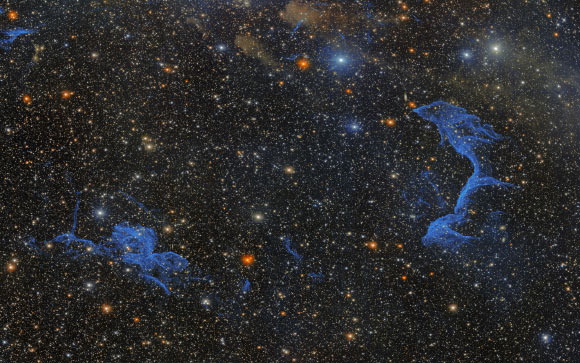
Utilizing the Dark Energy Camera on NSF’s Víctor M. Blanco 4-m telescope, astronomers have actually photographed a supernova residue that looks extremely like a betta fish swimming through the universes.
This image reveals a close-up view of one part of the supernova residue SNR G295.5 +09.7, nicknamed the Betta Fish Nebula. Image credit: CTIO/ NOIRLab/ DOE/ NSF/ AURA/ T.A. Rector, University of & Alaska Anchorage/ D. de Martin & M. Zamani, NSF’s NOIRLab.
The Betta Fish Nebula lies around 6,800 light-years away in the southern constellation of Centaurus.
Officially referred to as SNR G295.5 +09.7, the item was photographed by the Dark Energy Camera (DECam), a high-performance imager installed on NSF’s Víctor M. Blanco 4-m telescope at Cerro Tololo Inter-American Observatory in Chile.
“Nebulae are luminous clouds of matter drifting in the interstellar medium that are formed from gas, dust, and excellent product,” the astronomers stated in a declaration.
“This nebula might not have actually been imaged by an expert observatory before, making this image the very first of its kind.”
As its trade name recommends, SNR G295.5 +09.7 is the after-effects of a supernova.
When the star detonated, its external layers were blasted into area. The product broadened into the interstellar medium, knocking into surrounding gas and making it radiance. This interaction developed the blue filaments noticeable today.
The star’s staying core might not endure its own gravity and collapsed. The collapse stopped short of forming a black hole, as a neutron star formed rather.
“Total collapse was prevented through the development of a neutron star, which beings in this image surrounded by the external shell of the nebula,” the scientists stated.
“Neutron stars are exceptionally little and extremely thick. They load about 1.4 times the mass of our Sun into a sphere 20 km (12 miles) in size.”
The Betta Fish Nebula sits within the Carina-Sagittarius arm of the Milky Way.
“In this image, countless stars from this arm rest in the background of the nebula,” the researchers stated.
“Hidden within the outstanding plethora are galaxies beyond our own.”
Find out more
As an Amazon Associate I earn from qualifying purchases.