As an Amazon Associate I earn from qualifying purchases.

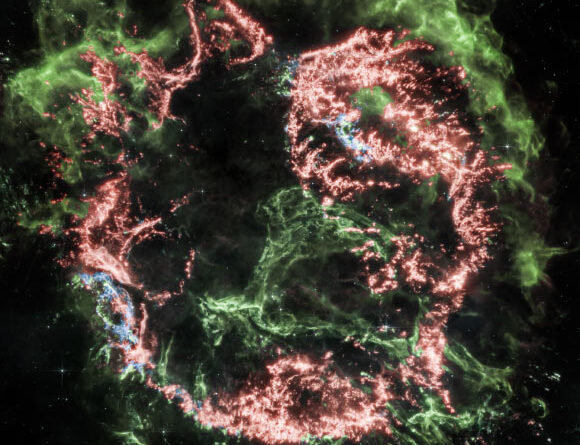
Utilizing the Mid-Infrared Instrument (MIRI) aboard the NASA/ESA/CSA James Webb Space Telescope, astronomers have actually separated dust emission from specific clumps of particles in Cassiopeia A, the youngest recognized supernova residue in our Milky Way Galaxy.
Webb exposes the hot dust that comprises Cassiopeia A. Image credit: NASA/ ESA/ CSA/ STScI/ Tea Temim, Columbia University/ Rick Arendt, UMBC/ Dan Milisavljevic, Purdue University/ Joseph DePasquale, STScI.
Cassiopeia A lies about 11,000 light-years away in the constellation of Cassiopeia.
Understood as Cas A, SNR G111.7-02.1 or NRAO 711, the item covers around 10 light-years.
When the initial star lacked fuel, it collapsed onto itself and exploded as a supernova, potentially quickly turning into one of the brightest items in the sky.
Astronomers believe that this taken place around the year 1680, there are no proven historic records to validate this.
“With Webb, the huge enhancement in having the ability to deal with at the private clump level assists us do more advanced dust chemistry,” stated Dr. Dan Milisavljevic, an astronomer at Purdue University.
“As an outcome, we can connect the surge back to the makeup of the progenitor star centuries later.”
“It’s informing us about what was occurring, we believe, in the hours leading up to core collapse.”
“Understanding this procedure is vital to describing which aspects the supernova surge will launch into the galaxy and how those aspects enhance future generations of stars and worlds.”
Earlier observations by Webb blurred numerous areas together, so the dust appeared to be an unpleasant mix.
The telescope’s sharper vision reveals otherwise: each clump is controlled by simply a couple of kinds of grain.
In a clump abundant in argon, the astronomers discovered that the dust is mainly silicon dioxide, the primary active ingredient of sand.
A neon-rich, carbon monoxide-rich clump is controlled by amorphous carbon, basically soot.
A 3rd area, inside the Green Monster, a structure of gas the star shed before taking off, is controlled by warm magnesium silicate.
Its circulation supports the concept that this product originated from the star’s environments instead of the surge itself.
The ejecta dust indicate what was inside the star. Silicon dioxide recommends an area with a great deal of silicon relative to magnesium, while carbon dust recommends carbon was left over after oxygen was locked into carbon monoxide gas.
The scientists compared those conditions with computer system designs of blowing up stars.
Just designs in which the star’s carbon- and oxygen-burning layers combined before the surge produced both areas simultaneously.
“Our research study shows that spatially fixed dust structures can supply restraints on the chemical structure and residential or commercial properties of core-collapse surges, with more comprehensive ramifications for translating unsolved mid-IR emission from extragalactic supernovae,” the researchers concluded.
The research study was released in the Astrophysical Journal Letters
_____
Tea Temim et al2026. JWST Resolves Dust Emission from Individual Ejecta Clumps in Cassiopeia A: Dominant Grain Compositions Point to a Shell Merger in the Progenitor. ApJL 1012, L26; doi: 10.3847/ 2041-8213/ aea901
Learn more
As an Amazon Associate I earn from qualifying purchases.